To live in Nebraska is to live on or at least near former prairie land. This ecological history is all around us. Up close, prairies hum and buzz. They’re full of color too. From a distance, that same land looks daunting, spare, capacious, and above it rises an even bigger sky. University of Nebraska alum Willa Cather puts it this way in My Antonia:
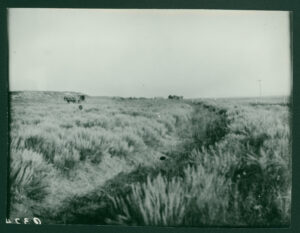
photograph courtesy of Nebraska State Historical Society
There seemed to be nothing to see; no fences, no creeks or trees, no hills or fields. If there was a road, I could not make it out in the faint starlight. There was nothing but land: not a country at all, but the material out of which countries are made […] I had the feeling that the world was left behind, that we had got over the edge of it, and were outside man’s jurisdiction. I had never before looked up at the sky when there was not a familiar mountain ridge against it. But this was the complete dome of heaven, all there was of it.
The poems featured in On the Prairie come from a range of nations and eras, but all remind us, in ways large and small, of the natural wonders of the Nebraska landscape.
Life and Creativity in “To make a prairie”
by
Andrés López, Editor
Spring 2026
“To make a prairie” is not only another astounding poem by Emily Dickinson but a catalyst for creativity in all settings, even the ones people consider “fly-over states.” Dickinson spent her entire life in Massachusetts, and the prairies there must differ from the ones we see in the Midwest and Nebraska, but she reminds us that beauty can be found in simplicity anywhere—especially in the prairies in our own backyards.
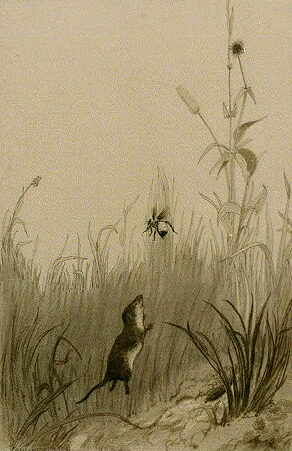
For Nebraskans, the prairie isn’t some emerging, contested image – it is home. Dickinson connects the boundless fields, not to mundanity, but to life and creativity. The word “revery” tells us the prairie is more than a physical location. It’s a state of being, one urging us to create, even in the “common” spaces. This revery is the heart, the soul we find on the prairie, whether in Massachusetts or Nebraska. It emanates beauty even when the only sound is crickets chirping. Dare I say, those cricket-chirps are exactly what Dickinson wants us to explore and admire – the simple object or creature as a form of immense beauty.
Dickinson challenges us to find imagination and a creative spirit in simplicity. To find in clovers and bees a connection to the human experience. To find in the prairie not empty space but inspiration. To find revery and sit in those feelings.
To pluck a blade of prairie grass, dip it in an inkwell, and create.
To make a prairie
Emily Dickinson
To make a prairie it takes a clover and one bee,
One clover, and a bee.
And revery.
The revery alone will do,
If bees are few.
(1755)