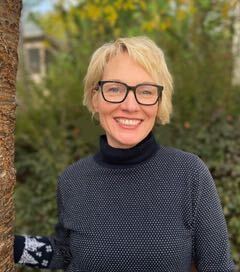
Bella Hardy: Firstly, how much do you recall from submitting to Laurus? What inspired you to write your first ever submitted piece?
Erin Flanagan: I wrote the story for a fiction writing class at UNL and my professor, Marly Swick, encouraged me to submit.
BH: What would you change about the work you submitted if there is anything?
EF: I’m sure there’s lots I would change, but sometimes the joy of publication is knowing you can’t and that the story works as a snapshot of who you were as a writer at that time. I remember in graduate school at UNL, faculty member Ted Kooser told me that “if you look back on your writing from five years ago and you’re not a little embarrassed, you’re not growing enough as a writer.” I still think about that all the time.
BH: How did it feel to have your first publication be with our student led undergraduate magazine? Did it make you anxious for more and boost your confidence?
EF: It was my first time feeling like a “real writer” and the validation of that made me think I really would pursue writing. Maybe not full time, and maybe not as a paying gig, but the publication let me know this was something that really mattered to me and was maybe something I was good at and should pursue. All the anxiety came later lol.
BH: From start to finish, what is your writing process? Do you find it best to do on the computer, a napkin, or random journaling? Do you have a playlist you listen to?
EF: I like to write at the computer with total silence at home, or [contrastingly] at a bustling coffee shop. Like many writers, I’m an introvert, but I love the sounds of other people working around me and the collective, creative hum. Writing at coffee shops also forces me to put on real-person pants and leave the house.
BH: For creative writing specifically, where did you get your start? Was it integral to your growing up? What happened to be your favorite kind of stories?
EF: I wrote as a kid but it wasn’t until I was an English major at UNL and took some creative writing courses that I really fell in love with reading and writing and decided to dedicate a portion of my life to those pursuits. As for what I love to read, those years as an undergraduate were so formative. I read contemporary short stories for the first time. I read widely outside of my own experience. Those years taught me to love complicated, flawed characters and approach them with empathy.
BH: Would you be able to tell readers about one of your first writing projects? The earlier the better!
EF: The story in Laurus was the first I wrote that I think held together from beginning to end. It was a little gimmicky, and very different from what I write now, but the important thing was that I saw it through. As for why it was gimmicky, I think I was writing toward an end that felt a little bit like a gotcha [moment]. I wouldn’t necessarily do that today, but I remember being really proud of the story at the time. It’s easy to have an idea for a story but much harder to execute, and I remember spending a lot of time on that piece. It taught me how to love the work.
BH: Okay, I know everyone asks what a favorite book/trope may be, but I want to know your LEAST type favorite book to read? Do you find there are still things to glean from such material regardless?
EF: I love reading novels that are hugely popular to try and figure out what the heck everyone is responding to—the pacing, the plot, genre conventions, the twists. Even if the elements are executed in ways that aren’t my cup of tea, these books have a lot to teach me about writing and what sells. It’s good for writers to figure that out and see if they can implement it in their own work.
BH: To state the obvious, you have written quite a few novels! Which is such a grand achievement unto itself. Which one did you have the most fun writing? Which do you feel was the one best received?
EF: The most fun novel to write is the one that’s done, [ha!], or the one that’s already been through a few revisions and that I am confident now is going to hang together. Once everything is in its right place in the book and the structure is sound, going back and revising on a language level is my favorite part.
As for which was the most well received, I’ll say Deer Season which was published by the University of Nebraska Press and won—to my great shock and delight—the 2022 Edgar for Best First Novel. I will always love that book because I feel like it changed my career.
BH: And finally, what makes you want to write? Do you have any advice for future submitters, what would you want to say to them?
EF: So many things make me want to write: a desire to communicate something to the world, an itch like something is missing if I don’t, the solidarity I feel with the literary community, not wanting to feel like a fraud with my students. Every day I feel like what makes me want to write changes, but as long as I still want to write, I try not to question it too much.
As for advice, I really try to ingrain in my students that talent is overrated. Writing is about hard work and showing up and tenacity—all things available to everyone. Depending, they find this either encouraging or discouraging, but I swear I mean it as the former.